
Reviewed · SELF-GUIDED TOURS
Private Self-Guided Audio Tour in Santorini
Santorini stories start the moment you press play. This private self-guided audio tour strings together major highlights across the island, with offline listening so you do not burn your data plan. I especially like the multi-language audio and written guide options, and the way it adds context to places you might otherwise just snap photos of.
Here is the trade-off. The audio is great at the stops, but the app is not a full GPS navigator, so you still need to plan your walking route before you go, especially around the caldera paths and the small lanes.
In This Review
- Key takeaways before you start your Santorini loop
- How this self-guided audio tour really works
- Price and value: why $9.67 might feel smart
- Starting at Thira Port, then building a realistic route
- Oia Windmill and the 300 steps: the classic photo stops
- Firostefani Central Square: views with a calm pace
- The cave museum and Lost Atlantis: myth meets technology
- Akrotiri’s Black Beach and the Akrotiri Lighthouse
- Fira and the 13th-century maritime village feel
- Imerovigli: Balcony to the Aegean and Skaros Rock
- Monolithos and the 1947 cooperative winery
- Santorini Brewing Company and the small side stops that add charm
- GPS problems are the main risk, so plan around them
- Best for who? When this audio tour clicks
- Should you book this Santorini audio tour?
- FAQ
- What language options are available for the audio guide?
- Do I need an internet connection to use the tour?
- How do I access the tour after booking?
- Does the tour include museum tickets or entry fees?
- Is this tour private or shared with other groups?
- Where does the tour start and end?
Key takeaways before you start your Santorini loop
Offline audio you can keep using without roaming
Audio typically starts when you arrive, not while you walk
A big stop list for a 1 to 3 hour experience, so you must choose
No museum tickets or entry fees are included
In-app mapping can miss the mark, but you can switch to Google Maps or Waze for voice directions
You are on your own with just your group, no in-person guide
A few more ways to fill a day on Santorini
How this self-guided audio tour really works
This is a smartphone audio guide you activate with a link. You also get a downloadable audio-guide map, plus offline content, so the stories keep playing even when reception gets spotty. You are not relying on a ranger-type host to lead you step-by-step, which means the pace is yours.
The format is simple. You use the phone to move between sights, then the guide gives its talk at each point of interest. One practical point: the audio is designed to begin after you reach the location, not as live turn-by-turn guidance.
If you expect GPS-style navigation inside the app, adjust that expectation up front. The in-app map is meant to show a walking path, and then you follow your nose the rest of the way. If that is not your style, you can open external navigation for voice directions.
Price and value: why $9.67 might feel smart
At about $9.67 per person, you are paying for content more than for logistics. This works in your favor if you like learning while you walk and you already plan to get around on foot and short connections between areas.
You also get real flexibility. The tour runs 12:00 AM to 11:30 PM every day in the listed validity dates, which helps if you want to fit it around sunsets, dinner plans, or heat breaks. And since it is private for your group, you avoid the stop-and-go rhythm that can happen on group tours.
Where value can slip is if you try to tackle every single listed stop. The full island route sounds like a full day, but the listed duration is about 1 to 3 hours. Treat it like a curated highlight sampler. Pick a manageable slice, and you get the payoff without the sprinting.
Starting at Thira Port, then building a realistic route
The meeting point is the Thira Santorini Port, Ormos Athiniós. The activity ends back at the same location, so the idea is round-trip within your own routing plan.
Because the stop list covers multiple towns and cliff-top villages, you will want a simple strategy:
- Choose one main zone (Oia, Fira, Imerovigli, Akrotiri, Megalochori, or Monolithos).
- Add only a few nearby stops per zone.
- Leave room for stairs and viewpoint wandering.
If you do not plan ahead, you can end up with the exact problem the map can create: wrong turns or confusing segments that feel walkable only on paper. My advice is to use the audio guide for storytelling, and use navigation apps for routing.
Same caldera, a different way to spend the afternoon:
- Santorini: Volcanic Islands Cruise with Hot Springs Visit★ 4.4 · 10,869 reviews
- Santorini: Catamaran Tour with BBQ Dinner, Drinks, and Music★ 4.6 · 5,886 reviews
- Premium Small-Group Catamaran Cruise with BBQ, Open Bar, Transfer★ 5.0 · 4,209 reviews
- Santorini Classic Catamaran Cruise with BBQ, Drinks and Transfers★ 5.0 · 3,933 reviews
- Santorini: Luxury Catamaran Day Trip with Meal and Open Bar★ 4.8 · 3,678 reviews
Oia Windmill and the 300 steps: the classic photo stops
Oia gets a star role here, and that makes sense. You start with the Windmill of Oia, a signature landmark tied to Santorini’s maritime past and the island’s built ingenuity. The audio context helps you understand that this is not just a postcard prop. It is part of a practical seafaring story.
Next comes the 300 steps. The key idea is what the steps were for. They were cut to move goods between the port area and the hilltop village, and the audio frames them as a working route that shaped daily life.
If you are the type who likes to know why a place exists, you will enjoy this pairing. The windmill gives you architecture. The steps give you movement and trade.
Practical note: stairs mean sensible shoes. If your feet are not happy with steep descents and climbs, you may want to do the steps earlier in the day before your energy drops.
Firostefani Central Square: views with a calm pace
Firostefani Central Square is a great mid-route pause. It is perched above the caldera, in a spot where history and views show up together. You also get audio that links the area’s elevated setting to the island’s maritime culture.
This stop is also useful as a pacing tool. Instead of forcing your route to feel like a checklist, you can use Firostefani as a slower segment. Listen, look, and take a breath.
If you are planning your route, think of Firostefani as a good “hang out” stop. The setting suits short photo breaks and longer conversations, even if you only spend a few minutes at the square.
The cave museum and Lost Atlantis: myth meets technology
Two of the most distinct stops in this audio route are for people who enjoy story worlds, not just monuments.
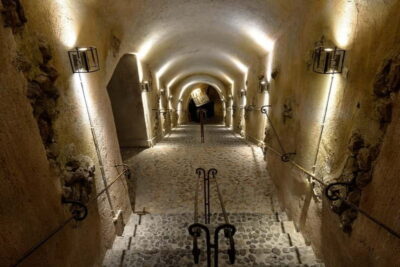
First, there is a museum set in a natural cave, extending about 300 meters below ground. The audio theme covers a timeline from the 1600s to the present day, so it is built to explain how the island’s past leads into what you see now.
Then there is the Lost Atlantis Experience in Megalochori. This is described as an interactive museum where history and myth connect through cutting-edge technology. The big value for you is that it turns Santorini legends into an organized experience instead of scattered trivia.
One important reality check: the tour does not include museum tickets or entry fees. So the audio can guide you toward these places, but you will need to pay separately if you want to go inside.
Akrotiri’s Black Beach and the Akrotiri Lighthouse
Akrotiri brings a different flavor. You get Black Beach, with volcanic black sand meeting the Aegean. The audio contrast matters here. It helps you see that the beach is not only scenic, it is geological evidence of how active the island’s past has been.
Then you move to the Akrotiri Lighthouse, built in 1892. You are given a sense of it as a working marker for sailors, placed at the edge of cliffs where visibility and warning mattered.
This pair works well if you want both land and sea logic. The beach tells you what the island is made of. The lighthouse tells you why humans built something there.
If you plan a short route, these two stops can anchor your time. They are conceptually linked, even if you just use the audio and spend most of your time outside, soaking in the views.
Fira and the 13th-century maritime village feel
Fira is the hub, and the audio here ties the town to the caldera and submerged volcanic crater views. It also frames Fira as a town established in the late 18th century and shaped into a lively center of narrow streets and lookout energy.
The route also references a nearby village built around maritime industry in the 13th century, with narrow streets and shops, cafes, and art galleries. Even if you do not enter every shop, listening while you walk makes the town feel more “designed by history” rather than simply touristy.
This area is also where you can flex your time. If you have limited energy, stick to Fira’s main viewing areas and a couple of listen points. If you have time, you can add a gallery or winery stop.
Imerovigli: Balcony to the Aegean and Skaros Rock
Imerovigli is described as the Balcony to the Aegean. The audio theme emphasizes its high caldera edge position, and even a defensive purpose during medieval pirate threats. That context makes the views feel strategic, not accidental.
You also get Skaros Rock in Imerovigli, tied to history and myth. This is the kind of stop where the audio matters most. You are not just looking at a shape. You are being coached on how locals and legends have interpreted the place over time.
If you are unsure what to pick on a short trip, Imerovigli and Skaros are a smart choice. The scenery gives you the emotional hit, and the audio gives you the meaning. The rest of the island becomes easier to connect in your head.
Monolithos and the 1947 cooperative winery
Monolithos is introduced as a village connected to a solitary rock formation in the landscape and the idea of secrets in antiquity. It is a good stop if you like a calmer village vibe compared to the busiest cliff-top strips.
Then the route includes a cooperative winery founded in 1947, focused on preserving and promoting traditional winemaking practices. That matters for value because you get an audio layer that explains why the winery exists the way it does, not just a sign you pass by.
As with the other museums and attractions, the audio guide will not handle entry. If you want a tasting or a formal visit, you will likely need to pay separately.
Santorini Brewing Company and the small side stops that add charm
Not every highlight on this route is an ancient ruin. You also get Santorini Brewing Company, founded in 2011 in Episkopi Gonias. The audio frames it as part of Greece’s craft beer scene, and adds the fun detail that the founders include people with different backgrounds: a Greek, a Serbian, an Englishman, and an American.
This kind of stop is a win if you like modern Santorini alongside the classic scenery. It gives you a taste of how the island keeps creating culture after the volcanic myths.
The route also includes other “off-center” attractions that work well as optional stops if you are already nearby:
- A Tomato Industrial Museum in Vlichada, tied to agricultural heritage and industrial evolution.
- An Art Space Art Gallery, Winery, and Museum in Exo Gonia.
- A Museum of Prehistoric Thera in Fira, positioned as a place preserving Aegean civilization history.
- Santorini Horse Riding in Megalochori, which you can treat as a location to check if it fits your plans.
Again, no museum tickets are included. So use these as either listening stops from outside, or as places where you decide to pay for entry based on your time and interests.
GPS problems are the main risk, so plan around them
The clearest criticism is about navigation. The app can show a map, but it does not give full audio directions for how to get from point to point. In some cases, the mapping can route you through roads that are not comfortable or not realistically walkable.
If you want a low-stress experience, do this:
- Use the app to enjoy the audio content once you arrive.
- Use Google Maps or Waze for turn-by-turn walking.
- Do a quick route check before you set off.
One more small note: there is a question feature in the app with a character named Diego, and one person found it childish. If you are the type who hates extra pop-ups while walking, you might want to stay ready to ignore that part and focus on the audio.
Best for who? When this audio tour clicks
This works best if you:
- Prefer self-guided pacing and small discoveries.
- Like learning in the moment rather than reading a guidebook later.
- Want a low-cost way to add context to classic Santorini stops.
- Can handle stairs, uneven paths, and some route planning.
It may not fit if you:
- Want hand-holding navigation from start to finish.
- Have limited mobility and need guaranteed step-by-step routing.
- Are planning to hit the entire stop list in one stretch.
Also, because it is private for your group and runs without an in-person guide, it is a good fit for couples, families, and friends who want quiet listening time.
Should you book this Santorini audio tour?
I’d book it if you want a budget-friendly way to understand what you are seeing, not just take photos. The combination of offline audio, multi-language guide options, and a private setup is strong value at around $9.67 per person.
Hold off or adjust your plan if navigation stress would ruin your day. This is an audio guide first, not a full route planner. If you are picky about directions, pair it with Google Maps or Waze and keep your expectations realistic about walking between far-flung towns.
If you do book it, my top tip is to pick your zone first, then choose only a handful of stops inside that zone. You will spend less time wandering, and you will get more out of every listening moment.
FAQ
What language options are available for the audio guide?
The audio and written guide are offered in English, plus additional languages including Spanish, French, German, and Italian.
Do I need an internet connection to use the tour?
No. The tour includes offline content to avoid roaming charges, and you can download and use it on your smartphone.
How do I access the tour after booking?
You receive an activation link and a mobile ticket. Once activated, you can use the audio guide during your visit.
Does the tour include museum tickets or entry fees?
No. The tour does not include museum tickets or any entry fees.
Is this tour private or shared with other groups?
It is private. Only your group participates.
Where does the tour start and end?
It starts at Thira Santorini Port, Ormos Athiniós, and it ends back at the same meeting point.
Newest around the caldera
- Island Tour Daytime with Winery visit & Wine Tasting Lunch
★ 5.0 · 1 review - Sanotini Oia Wine Tasting and Local Places Half Day Tour
★ 5.0 · 1 review - Flying dress Santorini
★ 5.0 · 1 review - GROUP FLYING DRESS PHOTOSHOOT in Santorini
★ 5.0 · 1 review - Private Wine Tour on Santorini Local Wines and Sunset Views
★ 5.0 · 1 review - Santorini Private 8 hours Sightseeing Tour
★ 3.0 · 1 review - Santorini: The Perfect 6-Hour Highlight Island Tour!
★ 5.0 · 1 review - Santorini organised day tour 5 hour
★ 3.0 · 1 review
Self-Guided Tours, compared.
Wine Museum Ticket with Tastings and Audio Guide
Read our review →

Akrotiri Ticket with Optional Self-Guided Audios
Read our review →
Authentic Santorini: A Self-Guided Audio Tour of Oia
Read our review →Browse the lists this tour appears in